Quote · Added 13 February 2026
Pure mathematics is, in its way, the poetry of logical ideas.
Albert EinsteinObituary for Emmy Noether, New York Times, May 5, 1935
No ratings yet
Filed undermathematics·poetry·logic
Quote · Added 13 February 2026
Filed undermathematics·poetry·logic
There's something almost romantic about the way mathematicians describe what they do. They talk about elegant proofs the way poets talk about a perfect line—there's a beauty that goes beyond just "getting the right answer." Einstein understood this because he worked at the frontier where precision and imagination collide. A pure mathematical insight doesn't need to explain the physical world to matter; it exists in this crystalline space where ideas follow their own internal logic, and that logic is breathtaking.
We tend to think of math as the opposite of poetry—one's rigorous and practical, the other is about feeling and metaphor. But they're closer cousins than we realize. Both involve discovering something true that wasn't obvious before. Both rely on constraint to create meaning; a sonnet's power comes partly from its rigid structure, just as a mathematical proof's elegance comes from doing more with less. When a mathematician finally sees why something must be true, that moment of sudden clarity is as close to inspiration as you get.
This matters because it reframes how we think about logical thinking itself. It's not cold or soulless. Following an idea to its deepest conclusion, whether you're working through abstract algebra or grappling with a difficult decision, activates something creative inside us. There's beauty in thinking clearly.
1879–1955·lived 76 years
Albert Einstein was a renowned theoretical physicist known for developing the theory of relativity, one of the two pillars of modern physics. He is best known for his mass-energy equivalence formula E=mc^2 and was awarded the Nobel Prize in Physics in 1921 for his explanation of the photoelectric effect.
Also by Albert Einstein
God does not play dice with the universe.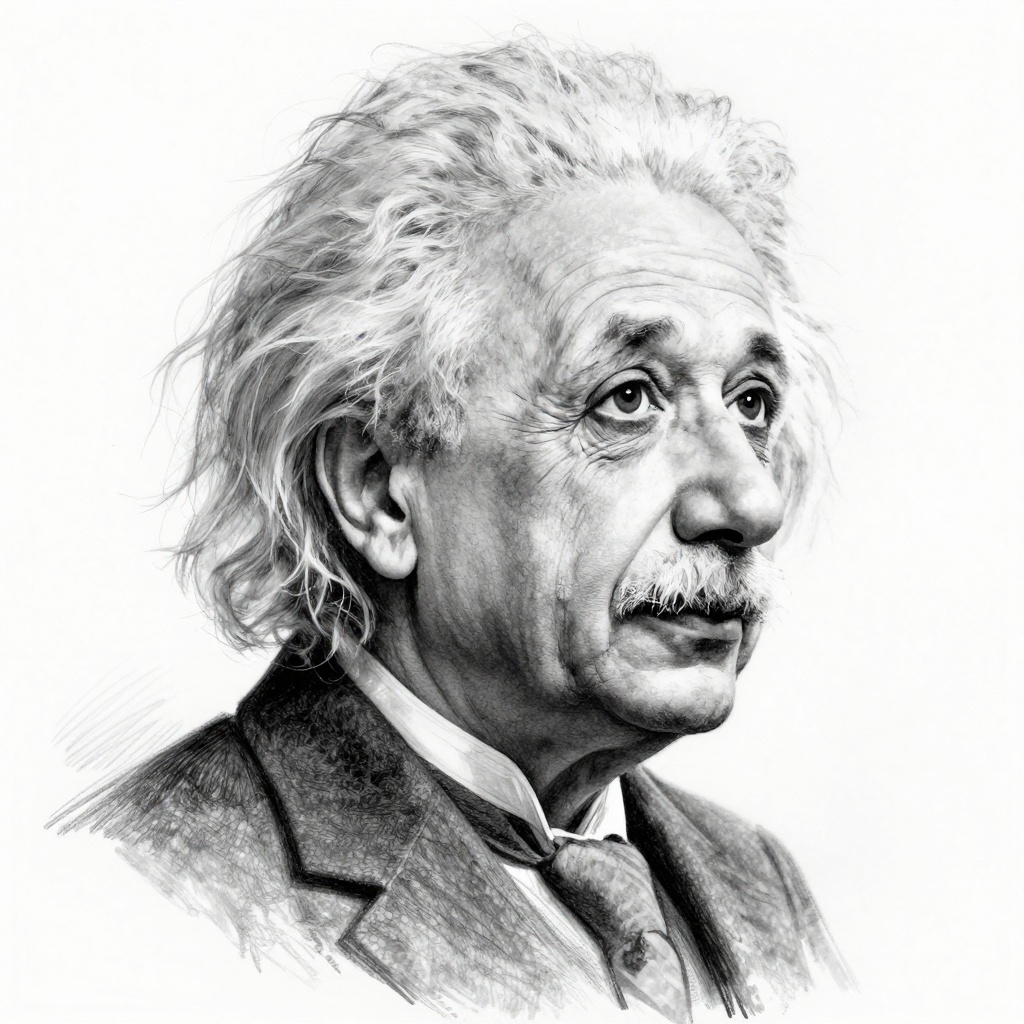
Comments