Quote · Added 5 July 2026
God does not play dice with the universe.
No ratings yet
Filed undergod·determinism·universe
Quote · Added 5 July 2026
Filed undergod·determinism·universe
Einstein was pushing back against a troubling implication of quantum mechanics: that reality operates on pure chance at its smallest scales. But his real worry extended far beyond physics. He was expressing a deep human instinct that the universe isn't random chaos, that there's an underlying order we can understand if we look hard enough.
What's interesting is how this quote reveals something about the tension between comfort and truth. We want the universe to be orderly because disorder is terrifying. A world where dice determine outcomes feels fundamentally unfair and unknowable. Yet Einstein's certainty that God wouldn't allow such randomness turned out to be personally limiting. Later experiments showed quantum randomness really is built into nature—not a sign of incomplete knowledge, but actual indeterminacy. He was so convinced the universe had to work a certain way that he resisted evidence pointing elsewhere.
That mirrors a modern problem. We all build mental models of how things "must" work, then get defensive when reality doesn't cooperate. The universe doesn't care about our need for order. Sometimes it does roll dice. The real wisdom isn't insisting everything must be rational, but staying curious when it isn't.
1879–1955·lived 76 years
Albert Einstein was a renowned theoretical physicist known for developing the theory of relativity, one of the two pillars of modern physics. He is best known for his mass-energy equivalence formula E=mc^2 and was awarded the Nobel Prize in Physics in 1921 for his explanation of the photoelectric effect.
Also by Albert Einstein
Bureaucracy is the death of all sound work.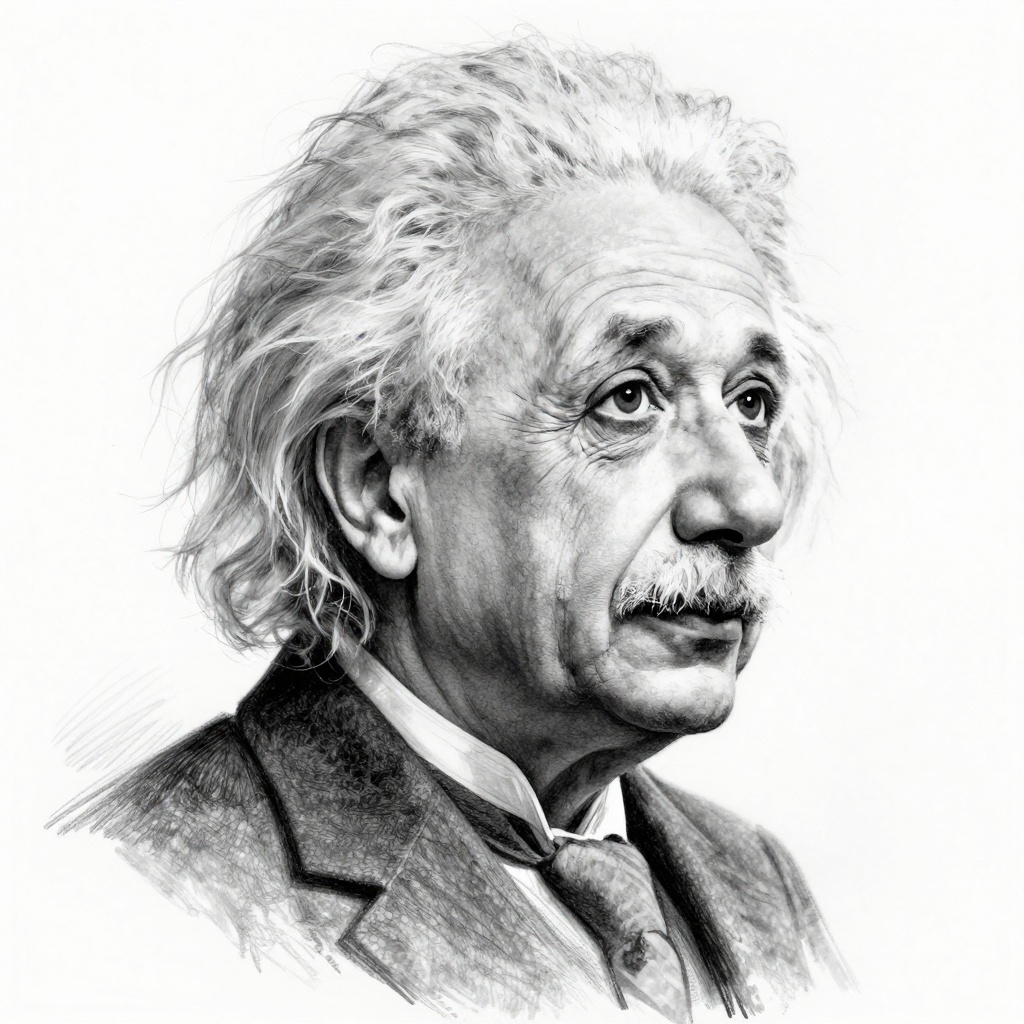
Comments