Quote · Added 13 February 2026
Nationalism is an infantile disease. It is the measles of mankind.
Albert EinsteinIdeas and Opinions, p. 36, 1954
No ratings yet
Filed undernationalism·disease·mankind
Quote · Added 13 February 2026
Filed undernationalism·disease·mankind
We tend to think of nationalism as something that happens at the government level—flags, military, trade wars. But Einstein was pointing at something more personal: the emotional appeal of it. He saw how easily people slip into thinking their country is naturally superior, their way obviously right, their group simply better. That feeling of belonging that comes from drawing a hard circle around "us" versus "them" can feel good, even protective. The problem is it stops us from thinking clearly.
What makes this comparison to measles so sharp is that measles is contagious and spreads fastest when people are already vulnerable. Nationalism works the same way. During uncertain times, when people feel economically threatened or culturally anxious, the appeal intensifies. We see it in how quickly "looking out for our own" can become "this group is a threat to us." That emotional momentum is hard to resist once it gets going.
The tricky part isn't recognizing nationalism in its extreme forms. It's catching it in yourself—in small moments when you're proud of your country in a way that quietly diminishes another one, or when you notice you're not even curious about why someone from elsewhere does things differently. That's where Einstein's point lands hardest. He's not saying love your home—he's saying the infantile part is when that love stops your thinking cold.
1879–1955·lived 76 years
Albert Einstein was a renowned theoretical physicist known for developing the theory of relativity, one of the two pillars of modern physics. He is best known for his mass-energy equivalence formula E=mc^2 and was awarded the Nobel Prize in Physics in 1921 for his explanation of the photoelectric effect.
Also by Albert Einstein
God does not play dice with the universe.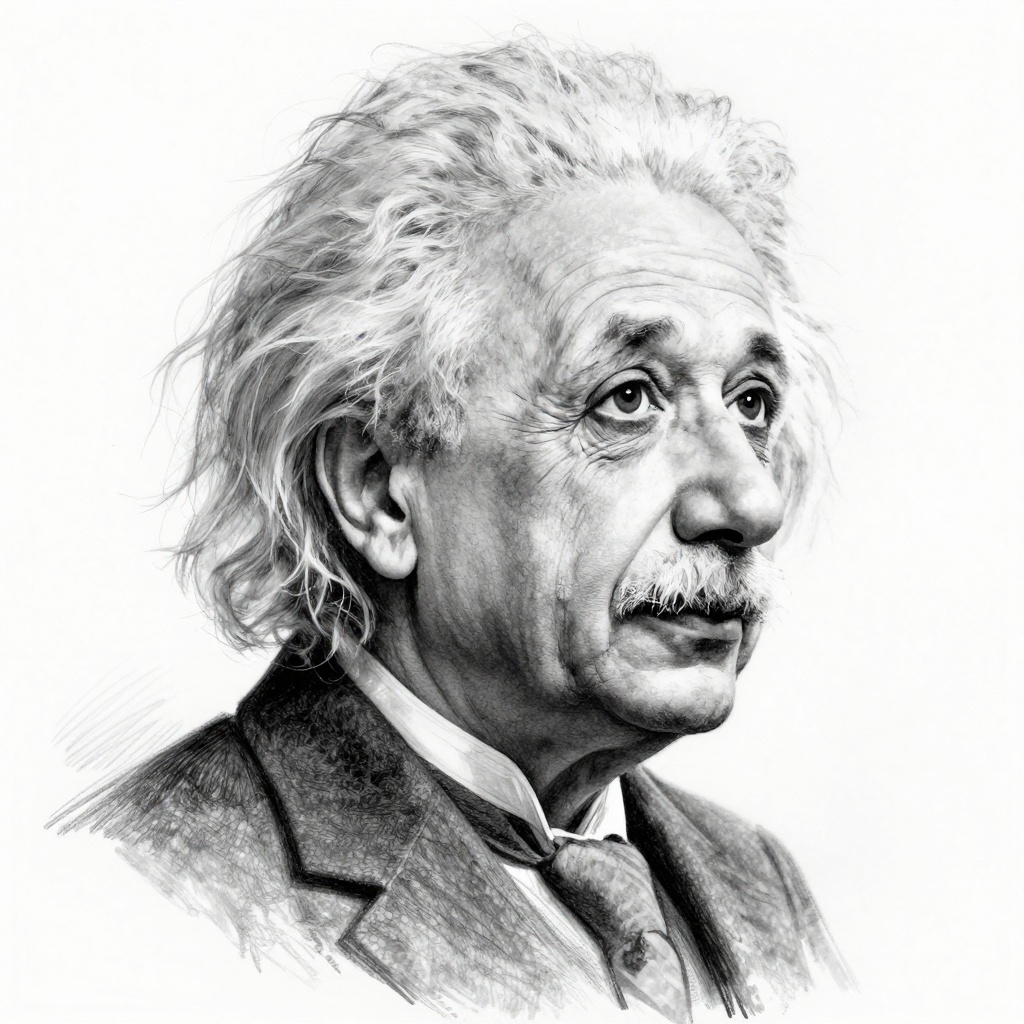
Comments