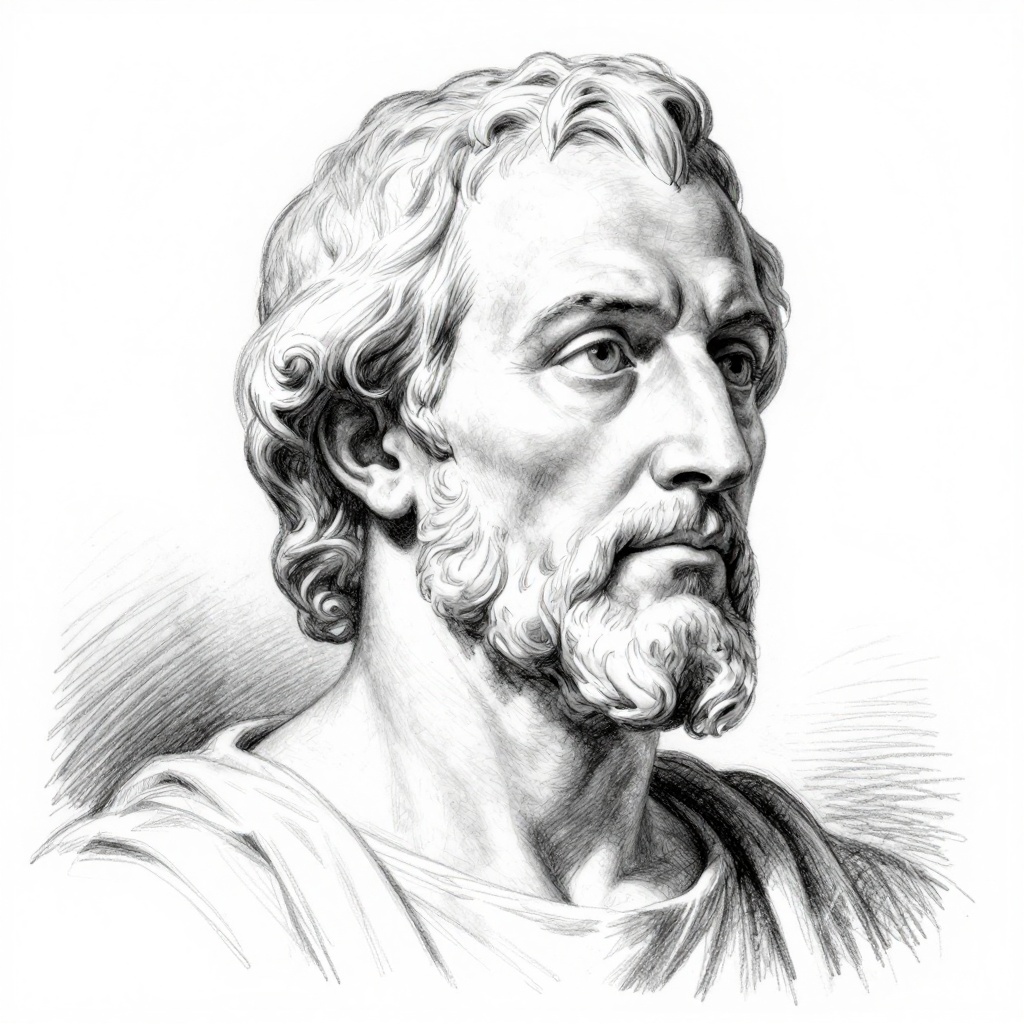
It is just that we should be grateful, not only to those with whose views we may agree, but also to those who... — Aristotle

It is just that we should be grateful, not only to those with whose views we may agree, but also to those who have expressed more superficial views; for these also contributed something, by developing before us the powers of thought.

Author: Aristotle

Insight: We're taught to seek out people who already think like us, to find our tribe and stay there. But Aristotle points at something stranger and more useful: even the people who get things partly wrong or incompletely right deserve gratitude. They're not just obstacles to bypass—they're actually part of how thinking gets better. Think about how your own mind works. You probably didn't arrive at what you believe by sitting alone. You argued with someone, read a take you half-disagreed with, or had to explain your position to a skeptic. That friction—even when it came from someone not thinking as deeply as you'd like—forced you to sharpen your reasoning. The superficial view made you go deeper. A colleague's half-baked idea might have sparked the thought that became your breakthrough. A relative's old-fashioned reasoning might have accidentally highlighted a gap in your logic. The twist is that this isn't about false tolerance or pretending bad arguments are good ones. It's about recognizing that intellectual growth doesn't happen in an echo chamber of the already-wise. It happens when we're challenged, even clumsily. So gratitude here isn't weakness or compromise—it's clear-eyed recognition of how minds actually develop. We become better thinkers partly through people thinking less well.

Source: Metaphysics, Book Alpha, 995a24-b4

It is just that we should be grateful, not only to those with whose views we may agree, but also to those who have expressed more superficial views; for these also contributed something, by developing before us the powers of thought.

AristotleMetaphysics, Book Alpha, 995a24-b4

Even wrong thinking sharpens yours

We're taught to seek out people who already think like us, to find our tribe and stay there. But Aristotle points at something stranger and more useful: even the people who get things partly wrong or incompletely right deserve gratitude. They're not just obstacles to bypass—they're actually part of how thinking gets better.

Think about how your own mind works. You probably didn't arrive at what you believe by sitting alone. You argued with someone, read a take you half-disagreed with, or had to explain your position to a skeptic. That friction—even when it came from someone not thinking as deeply as you'd like—forced you to sharpen your reasoning. The superficial view made you go deeper. A colleague's half-baked idea might have sparked the thought that became your breakthrough. A relative's old-fashioned reasoning might have accidentally highlighted a gap in your logic.

The twist is that this isn't about false tolerance or pretending bad arguments are good ones. It's about recognizing that intellectual growth doesn't happen in an echo chamber of the already-wise. It happens when we're challenged, even clumsily. So gratitude here isn't weakness or compromise—it's clear-eyed recognition of how minds actually develop. We become better thinkers partly through people thinking less well.

Comments

Sign in to leave a comment or reply to one.

Sign in

Aristotle

Aristotle was a Greek philosopher and polymath who lived from 384 to 322 BC. He is known for being one of the greatest thinkers in Western philosophy and for his contributions to a wide array of subjects including metaphysics, ethics, politics, biology, and logic. Aristotle was a student of Plato and the teacher of Alexander the Great.

Graph

Related