Quote · Added 28 February 2026
Three Rules of Work: Out of clutter find simplicity. From discord find harmony. In the middle of difficulty lies opportunity.
No ratings yet
Filed underwork·simplicity·opportunity
Quote · Added 28 February 2026
Filed underwork·simplicity·opportunity
We live in an age of maximum clutter—not just physical stuff, but infinite apps, notifications, opinions, and options. Einstein's first rule cuts straight to something most of us feel: that sense of being buried under complexity that doesn't actually require all that complexity. The clearest thinkers, the most effective people, usually strip things down to their essence. They're not being lazy; they're being precise.
The second rule hits differently now. We're trained to see disagreement as a problem to eliminate, but harmony doesn't mean everyone thinks alike. It means finding the underlying pattern or shared goal beneath the noise. A couple arguing about money might really be arguing about security. A team in conflict might be orbiting the same destination but taking different paths. Finding harmony means listening for what's actually trying to emerge.
But here's the angle that matters most: opportunity isn't some hidden prize waiting for lucky people. It's built into difficulty itself. When things are hard, friction points reveal what matters. During a crisis, suddenly priorities become obvious. When a relationship struggles, you learn what you actually value. The hard moment contains exactly the information you need, if you're paying attention.
1879–1955·lived 76 years
Albert Einstein was a renowned theoretical physicist known for developing the theory of relativity, one of the two pillars of modern physics. He is best known for his mass-energy equivalence formula E=mc^2 and was awarded the Nobel Prize in Physics in 1921 for his explanation of the photoelectric effect.
Also by Albert Einstein
God does not play dice with the universe.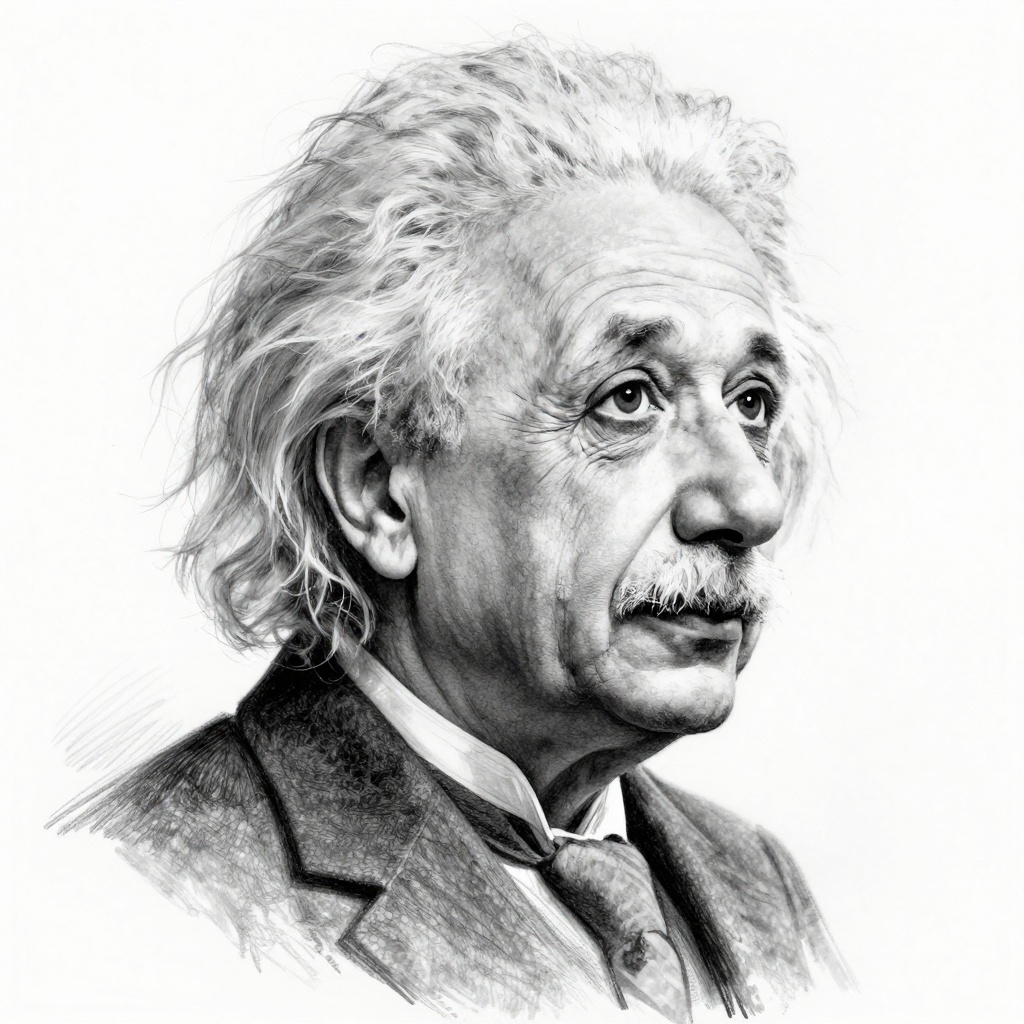
Comments