Quote · Added 13 February 2026
The gift of fantasy has meant more to me than my talent for absorbing positive knowledge.
No ratings yet
Quote · Added 13 February 2026
We live in a culture obsessed with gathering facts and credentials—more certifications, more data, more proof that we know things. Yet Einstein, a man who mastered some of the hardest knowledge humans have ever created, is saying something almost backwards: imagination mattered more to him than expertise itself. That's worth sitting with.
The twist is that fantasy isn't about escapism or making things up randomly. It's about the ability to see possibilities that don't yet exist, to connect dots in ways your current knowledge base doesn't immediately allow. A person can absorb every fact about how things work today and still be blind to what could happen tomorrow. But someone with a creative mind can look at the same world and ask "what if?" in ways that actually change it.
This matters now especially because we're drowning in information while struggling to imagine genuinely different futures. The problem-solvers who change things aren't usually the ones with the most facts stored up—they're the ones willing to think sideways, to entertain possibilities that seem impractical at first. Fantasy, in this sense, is the permission slip we keep forgetting to give ourselves.
1879–1955·lived 76 years
Albert Einstein was a renowned theoretical physicist known for developing the theory of relativity, one of the two pillars of modern physics. He is best known for his mass-energy equivalence formula E=mc^2 and was awarded the Nobel Prize in Physics in 1921 for his explanation of the photoelectric effect.
Also by Albert Einstein
God does not play dice with the universe.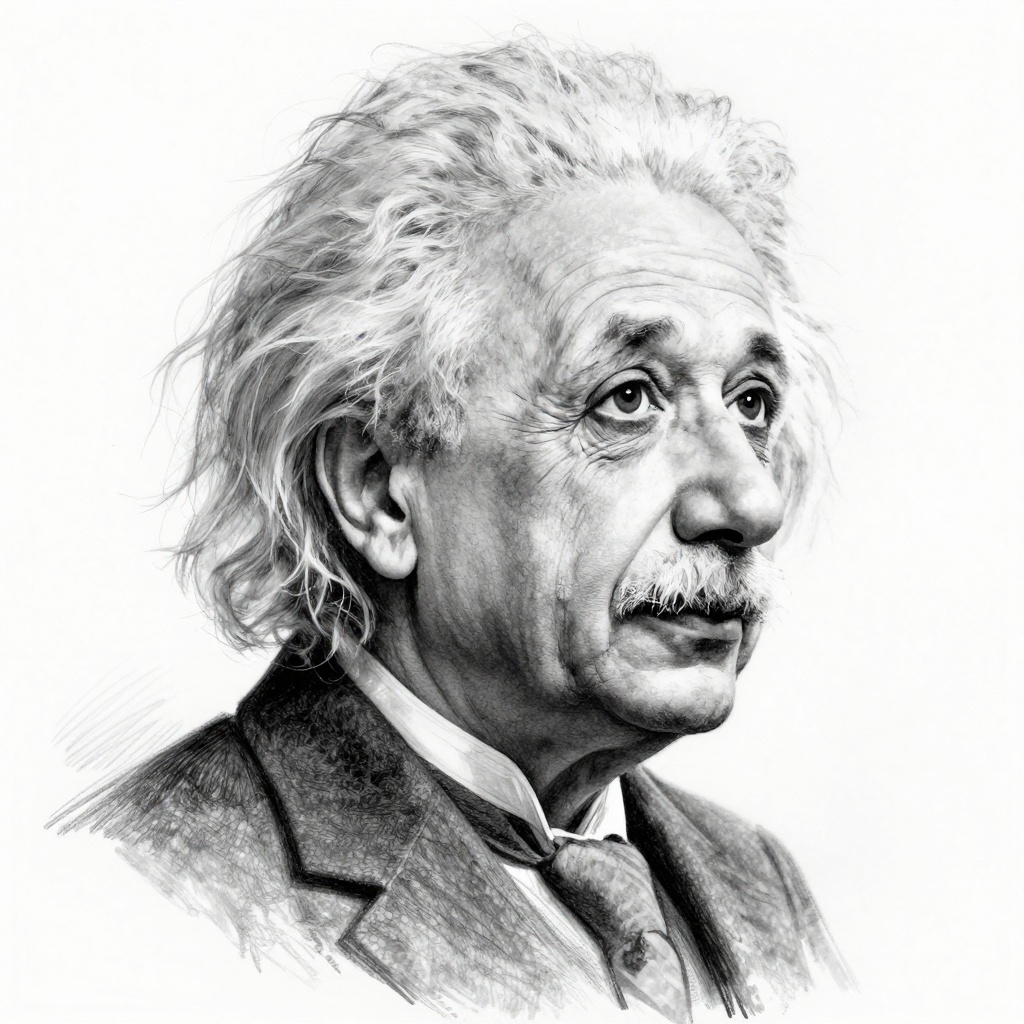
Comments