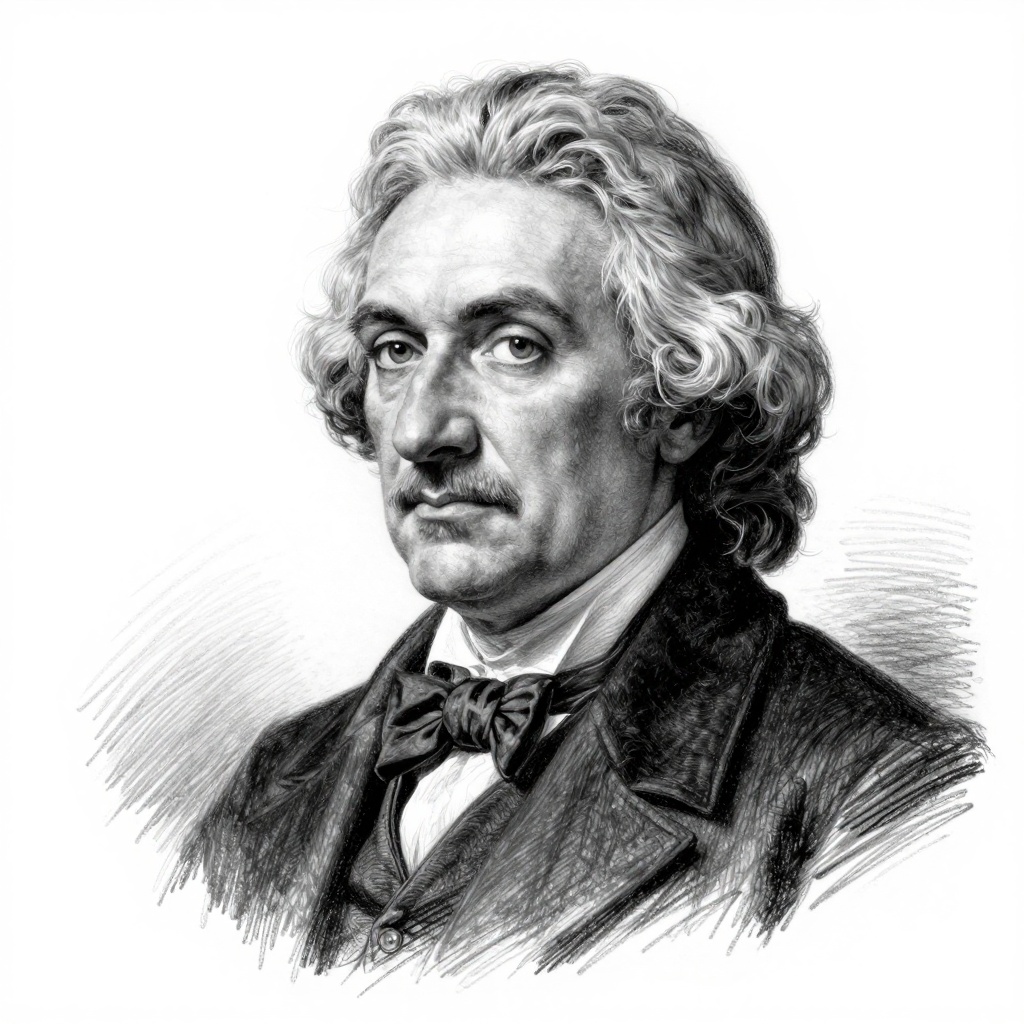
We must admit with humility that, while number is purely a product of our minds, space has a reality outside o... — Carl Friedrich Gauss

We must admit with humility that, while number is purely a product of our minds, space has a reality outside our minds, so that we cannot completely prescribe its properties a priori.

Author: Carl Friedrich Gauss

Insight: There's something quietly radical about admitting you're wrong about how the world works. Gauss, one of history's greatest mathematicians, is doing exactly that here—saying that math lives in our heads, but space itself has its own rules we have to discover, not invent. We tend to think of geometry as universal truth, carved into reality like laws of physics. But Gauss realized something stranger: the rules we use to measure and describe space might not be the only ones possible. There could be other geometries that work just as logically but describe different kinds of space. This wasn't just an abstract thought experiment—it opened the door to non-Euclidean geometry and eventually helped Einstein explain gravity itself. The everyday version of this is recognizing that our mental models aren't reality. We create useful frameworks for understanding the world—whether that's how we organize our schedules, relate to people, or explain why things happen. But the world keeps surprising us. The humbling part isn't admitting ignorance; it's accepting that reality might be fundamentally stranger than our most confident assumptions, and that's actually where discovery begins.

Reality Doesn't Take Our Orders

We must admit with humility that, while number is purely a product of our minds, space has a reality outside our minds, so that we cannot completely prescribe its properties a priori.

There's something quietly radical about admitting you're wrong about how the world works. Gauss, one of history's greatest mathematicians, is doing exactly that here—saying that math lives in our heads, but space itself has its own rules we have to discover, not invent.

We tend to think of geometry as universal truth, carved into reality like laws of physics. But Gauss realized something stranger: the rules we use to measure and describe space might not be the only ones possible. There could be other geometries that work just as logically but describe different kinds of space. This wasn't just an abstract thought experiment—it opened the door to non-Euclidean geometry and eventually helped Einstein explain gravity itself.

The everyday version of this is recognizing that our mental models aren't reality. We create useful frameworks for understanding the world—whether that's how we organize our schedules, relate to people, or explain why things happen. But the world keeps surprising us. The humbling part isn't admitting ignorance; it's accepting that reality might be fundamentally stranger than our most confident assumptions, and that's actually where discovery begins.

AI generated

Comments

Sign in to leave a comment or reply to one.

Sign in

Carl Friedrich Gauss

Carl Friedrich Gauss was a German mathematician and physicist who made significant contributions to many fields, including number theory, algebra, statistics, and electromagnetism. He is known for his work in mathematics, such as the discovery of the prime number theorem and Gaussian distribution, as well as for his development of Gaussian units in electromagnetism. Gauss is often referred to as the "Prince of Mathematicians."

Graph

Related